Amanda Azzopardi

Firstly, you’re not meant to make that decision alone.

It’s impossible to know which treatment is right for you without years of experience and expertise of the techniques available and how they work for different skin types.

As an Advanced Nurse Practitioner and Prescriber in Aesthetic Medicine, I’ve helped hundreds of individuals feel more confident in their own skin through tailoring the right aesthetics treatments for them.

How should a personalised aesthetics journey start?

With a one-to-one consultation.

Your consultation begins with a discussion of what your concerns are and what you’d like to achieve with aesthetics treatment.

Next comes an examination of your face when still (static) and when making expressions (dynamic) to assess how your skin moves. This is an essential part of a tailored consultation for 2 reasons.

First, it ensures that the most appropriate treatments are selected for your facial structure, targeting the specific aspects of ageing that you’re concerned about, from loss of facial contours and volume to saggy, dry skin.

Second, it provides vital information to ensure that the final results of whichever treatments you receive produce a natural look.

Your consultation will also involve a discussion of your budget, and time and lifestyle constraints, so that the final treatments selected work for your particular circumstances.

What outcomes should you expect from your consultation?

You may be surprised by the results of your consultation. For example, you may find that dermal fillers, which you thought were the answer, aren’t actually the right solution for you and that microneedling may be more appropriate.

With an experienced, licensed aesthetics practitioner that you trust, you should receive honest advice on the best treatments for your skin — even if that means your chosen aesthetics provider has to refer you elsewhere for those treatments.

What’s the next step?

If you’d like to know what the best aesthetics treatments are for you, book a consultation at Amanda Azzopardi Aesthetics on 07444 938 248 or 0151 558 0742, or get in touch here.

MEET THE AUTHOR

Amanda Azzopardi, an Advanced Nurse Practitioner and Aesthetic Medicine Prescriber, specialises in ageing-related changes. With a Masters in Advanced Clinical Practice, she's trained at the renowned Harley Academy in London and the Level 7 accredited Derma Medical Academy. Boasting over 15 years of global experience in acute medical settings and extensive aesthetic insurance, Amanda combines care, skill, and professionalism to ensure your treatments are in trustworthy hands.

book a consultation

Click the link below to book your consultation

RELATED POSTS

So how does it affect your facial appearance?

These age-related changes beneath the surface of the skin can make you look older more prematurely. Between the ages of 25 to 30, people reach their peak bone mass and by 40 it starts to deteriorate. Your body reabsorbs calcium and phosphate, instead of keeping it in your bones, making them weaker and when this process reaches a certain stage it’s called osteoporosis, which may lead to fractures and injuries.

Factors that contribute to bone loss include a low calcium diet, lack of exercise, smoking, and taking corticosteroids which are often used for disease processes such as asthma, bowel disease or lupus. The sources of calcium that you can replace in your diet include; milk, cheese, dairy foods, green leafy vegetables, soya beans and soya drinks, nuts and bony fish such as sardines.

Calcium, Vitamin D and Omega 3 supplements are always a really good idea to improve your bone strength, however, your bones are just one layer of your facial structure that deteriorates with age.

The next layer is the muscles and muscle loss or wastage with age is called sarcopenia. Muscle deterioration is a natural process, however, a sedentary lifestyle can accelerate deterioration of skeletal muscle mass, which are the muscles that attach themselves to your bones that start to deteriorate.

These changes start to occur in your 30s and rapidly accelerate through your 40s and 50s, leading to sagging, flabby, creepy facial features. These changes can be accelerated by disease or medications, but this layer is the easiest to build up by simply getting off the couch. A sedentary lifestyle and the TV are your worst enemies and the longer you stay active, mobile and flexible with your joints, the longer you will enjoy life.

Muscles take longer to react in your fifties, to the spread or transmission of impulses from your brain to your muscles, so you can’t respond as quickly and more injuries occur. Your heart muscle also becomes less able to propel large quantities of blood around your body. Our tendons tighten with age, this is the tissue that attaches the muscle to the bone, they become stiff and less able to tolerate stress as they lose water content leading to injury.

The next layer that has a significant effect on your appearance is the fat pads in your face, as they diminish and sag with age or weight loss.

The upper and middle third of your face loses structure and fullness and the lower third becomes heavy in appearance. When the fat pads are depleted, the skin begins to sag, you look hollow and wrinkled due to the loss of fullness. Fat pads in the upper face atrophy, waste away with age and the lower face hypertrophy become fuller, changing the triangle shaped face of youth into an aged, heavy, square looking face.

The deeper fat pads in the cheeks reduce in size and then cease to support the more superficial fat pads on the surface of the skin, and as they sag, the face loses its structure. The fat accumulates in the lower areas of the face and the skin loses its elasticity.

The other things that can occur are the eyebrows and eyelids start to droop, the wrinkles and lines become more obvious, as the underlying support structure collapses. Volume is lost under the eyes which makes you look tired, temples and cheeks become hollowed, which were previously hidden under the fat pad, now exposing the bony rims of your eyes, which is really ageing to your face.

The tip of the nose, and the nasolabial folds or the nose to mouth lines, become deeper as the cheek sags with heaviness, increasing these lines, the lips straighten, turning down with age and forming sad lines or marionette lines. The jowl sags, the jawline sags, jowls form at the front of your face leading to a turkey neck appearance. The loss of volume doesn’t occur evenly on both sides of our face, forming an enhanced asymmetrical appearance.

Facial features are not even on both sides to begin with, however, the loss of volume with age often exaggerates this. A saggy eyelid on one side or a saggy cheek on one side, and not the other, can be very upsetting and as the skin changes, these are the most visible signs of ageing, then the evidence of fine lines, deep wrinkles, white or grey hair.

Your skin is the largest organ in your body, it houses the nerve receptors that allow you to touch and feel pain plus also helps your body maintain its fluid and electrolyte balance. It’s susceptible to all the environmental pressures we put it under, such as sun exposure, sunbaking, smoking exposure, bacteria from make-up, toxins, radiation and we expose it to poor nutrition and periods of alcohol excess. And yet it STILL protects us from all of this, it really is amazing.

The skin is the first part of our body to sustain injury. To heal a wound, it protects us from the environment and it controls our body’s temperature.

The three main layers of the outer part of the skin;

The epidermis, which contains pigment cells and proteins, the middle part is the dermis, which contains skin cells or blood vessels, nerves, oil glands and provides nutrients to the epidermal layer and the inner layer the dermis which houses the sweat glands, blood vessels and the fat pads.

The ageing process makes the outer layer of the skin, the epidermis, thin, the number of pigment containing cells, the melanocytes decreases, so with ageing, the skin looks thinner, paler, clearer or more translucent. The connective tissue reduces, and the skin’s strength weakens, the blood vessels become more fragile, leading to and bruising under the skin and sebaceous glands produce less oil, leading to dry itchy skin.

Subcutaneous fat layers decrease, leaving you more susceptible to skin injury as you are more exposed to environmental temperatures. As the skin ages, skin growths appear, such as skin tags, warts, brown patches from sun damage, hormones and rough patches of skin.

The ageing process cannot be avoided, however, there are things we can do, to improve skin elasticity.

A good skincare regime will improve your overall firmness, collagen and elastin levels, to support the underlying fat pad changes. It is always a good idea to maintain good hydration and full sun protection, and not smoking will reduce the effects of ageing prematurely.

There are many anti-ageing treatment options.

In the past people chose to go under the knife adopting a more surgical approach to facial rejuvenation, however, they are now realising this simply lifts and tightens the skin, it doesn’t address the fat pads, and the depleted underlying structural layers, that are more pertinent in supporting the upper layers of the skin.

Now a safe and more effective option is to replace the volume in your face with dermal fillers, to lift the areas of fat pad loss and restore volume with a nonsurgical facelift. This has become very popular with an aim to rebalance the fullness across your face.

There’s been a lot of detailed advances in facial mapping in aesthetic medicine in the early 2000’s, which maintain that dermal fillers now can be incredibly, precisely and effectively used to restore fullness. By targeting the cause of the volume loss, and tailoring the approach to the patient’s specific needs, a natural and more holistic result can be achieved.

There is very little downtime with non-surgical procedures, in comparison to a surgical facelift and we can safely achieve a far more natural result, rather than simply using fillers to mask wrinkles. Your face will look more aged if you have lines and wrinkles, if you’re suffering fat pad and volume loss, sun damage with dark spots, or have dull or dry skin.

If you would like some advice on how skincare or dermal fillers can assist you to counteract the effects of the ageing process, please get in contact.

Amanda Azzopardi
Advanced Nurse Practitioner

MEET THE AUTHOR

Amanda Azzopardi, an Advanced Nurse Practitioner and Aesthetic Medicine Prescriber, specialises in ageing-related changes. With a Masters in Advanced Clinical Practice, she's trained at the renowned Harley Academy in London and the Level 7 accredited Derma Medical Academy. Boasting over 15 years of global experience in acute medical settings and extensive aesthetic insurance, Amanda combines care, skill, and professionalism to ensure your treatments are in trustworthy hands.


book a consultation

Click the link below to book your consultation

RELATED POSTS

Everyone has a unique skin type

That is different for everybody and requires a different skincare regime. Knowing your skin type is really important, as using a skincare regime that doesn’t suit your skin type, can be more damaging to your skin. 

Firstly let’s find out a bit about your skin. 


Male and female skin types vary greatly. Male skin is 25% thicker and has more collagen due to the male hormone testosterone, a male sex hormone that gives a man their male characteristics, while oestrogen is the female sex hormone, which gives a woman their female characteristics.

In general, as male skin is thicker, more oily and rougher in texture, it also ages differently to female skin. Female skin becomes dramatically thinner with menopause. Men have more active sebaceous glands and therefore more open pores. A man’s skin contains more collagen, which gives it that firm appearance. 
 
Adult males are less prone to dry skin than females, as sebum production is double that of women and as a result, the pH of the skin is lower, so it’s prone to more impurities, meaning men can just have a simpler skincare routine, which is great to improve their skin health. The most important things for a man are cleansing, rejuvenating, rehydrating, and protecting.
 
Signs of ageing for men appear much later in life, sagging skin, puffy eyes, dark circles. These features all make the face look aged and tired. Regular shaving makes the skin more stressed and susceptible to the external environment. Men can minimise the harm caused to the skin and things that will help include, staying hydrated, decreasing harsh aftershave, this drys out the skin rapidly. 
 
Men shave approximately 16,000 times in a lifetime and the skin becomes more and more sensitive every time, it also reacts faster. Daily shaving causes skin irritation, it removes the uppermost layer of the immature skin cells and exposes them to external influences and threats. Using a blunt razor or insufficient lubrication will lead to nicks, cuts and razor burns. 
 
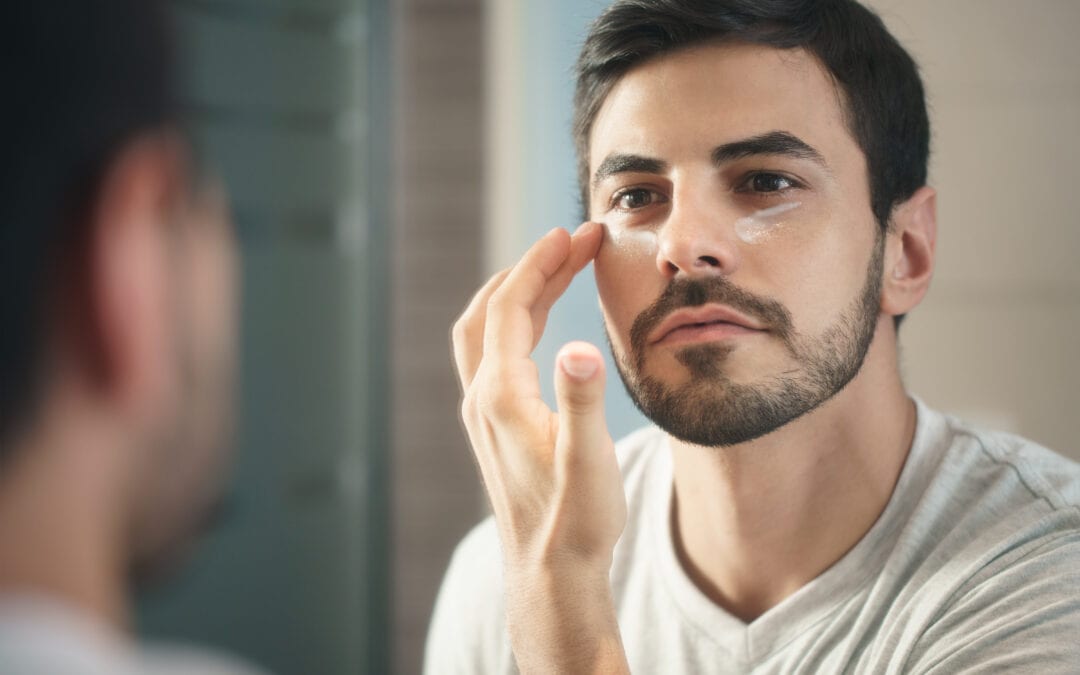
Male skin is so different to female skin. It benefits from a more dedicated approach to skincare, from products and knowledge that respect its unique biological properties. So when I see a man that has a face wash, that is 18 in 1 steps to a quick, fresh, squeaky clean skin, it just makes me cringe!! It’s not difficult or time-consuming it’s actually a lot easier than a woman’s daily skincare routine, you just need to cleanse, rejuvenate, moisturise, and protect.
 
Cleansing takes the daily bacteria off, so you don’t take it to bed. It unclogs the pores and if you use products that are too harsh for your skin type you will remove the skins natural lipid layer. You just can’t use the same soap or body gel on your face that you are using on the rest of your body in the shower, and please use shaving products that contain antibacterial properties to protect the skin from irritation and a clean sharp razor, for the closest shave in the direction the hair grows, not against it. 
 
Men need a suitable cleanser for their skin type. A cleanser can correct conditions such as acne and reduce the signs of ageing, leaving your skin feeling fresh, removing the bacteria which can lead to spots that become inflamed and infected. This needs to be done morning and night to take the bedbugs off your face and not take them into the day with you. 
 
Rejuvenating serums are the shortest path to a smooth, firm and more even tone and texture. Your body’s cells rejuvenate faster as you sleep and your systems work the hardest to correct and restore themselves during a full nights sleep. The skin is no exception, so it’s imperative that you cleanse in the morning and night and lather on in the nutrient-dense products and anti-ageing products such as retinal, which will magnify your complexion and keep yourself hydrated, nourished, protected and supported. 
 
Vitamin C is a great anti-oxidant for men. It enhances the skins own defence, giving you a firmer more even skin tone and it clears broken capillaries, promoting a smooth appearance. It retains moisture, reduces dry, red irritated skin, so it’s just barely a few drops in the morning and a few drops in the evening, that’s all it takes. 
 
Next a moisturiser. When the skin lacks moisture, it appears dull and can lead to various skin conditions such as eczema. A moisturiser will enable your skin to look and feel fresh, feel soft and healthy. Emollients such as shea butter and cocoa butter will protect, soften and lubricate. If the skin is oily and greasy, you still need to moisturise, using the specific type for your skin, with hydration to encourage healthy skin turnover from a cellular level, if you have oily skin and you don’t replace the moisture, your skin will produce more oil. 
 
We lose water and become dehydrated every day through evaporation, which we need to replace. The moisturiser acts as a barrier to prevent the skins’ hydration from being lost and protects it against the environment. 
 
The last one is sunscreen protection. Guys, regardless of the temp outside, an SPF broad-spectrum sunscreen is an essential part of your wash bag, to protect your skin from harmful UV rays. Wearing sunscreen is part of healthy sun-seeking behaviour, along with a hat, sunglasses, sitting in the shade and wearing protective clothing. Sunburn is bad for your skin, if you have multiple episodes of it, it causes direct damage to your DNA cells in your skin, which can promote skin cancer. Wearing an SPF from a medical point of view reduces your risk of developing skin cancer. Take steps to protect your skin even when it’s overcast, the UV rays still appear through the clouds and increase your risk of burning.
 
Why don’t most men wear sunscreen? It’s probably a mixture of marketing/education, media and masculinity, that’s the difference between men and women, wearing sunscreen. Marketing is usually targeted at women, the importance of melanoma awareness, knowing the signs of skin cancer and the importance of protecting your skin. 
 
Media campaigns are usually targeted at women preventing sun damage, for anti-ageing reasons, rather than skin cancer or melanoma. However, remarkably men are more likely to be diagnosed with melanoma, which is a really scary thing and has been scientifically linked to poor sun-seeking behaviours, such as topless sunbathing on holidays. 
 
A skincare routine for men is essential! You don’t need masks or toners, these are for the enthusiasts, but completely fine, if that’s for you. I can recommend some products, so contact me. If that’s not on your essentials list, just a few minutes a day can protect your skin and make it look easy years younger.

To summarise:

Cleanse to get the daily bedbugs off, twice a day.  
Exfoliate a few times a week, for a brighter complexion. 
Serums such as Vitamin C, provide a potent antioxidant to brighten the skin and prevent ageing. 
Moisturise twice each day to correct your barrier function
Use an SPF to prevent sun spots, wrinkles, burn, dry patches, moles and melanoma. 
Shield yourself from the suns rays, with that extra protective layer on top of your moisturiser. 
Throw out your 18 in 1 products from your vanity cupboard and get a good skincare regime for you.

Men…. you deserve it and you owe it to yourselves. You do deserve that great skincare regime, so let’s get you started. 

Amanda Azzopardi
Advanced Nurse Practitioner

MEET THE AUTHOR

Amanda Azzopardi, an Advanced Nurse Practitioner and Aesthetic Medicine Prescriber, specialises in ageing-related changes. With a Masters in Advanced Clinical Practice, she's trained at the renowned Harley Academy in London and the Level 7 accredited Derma Medical Academy. Boasting over 15 years of global experience in acute medical settings and extensive aesthetic insurance, Amanda combines care, skill, and professionalism to ensure your treatments are in trustworthy hands.

book a consultation

Click the link below to book your consultation

RELATED POSTS

To understand hair loss, we first need to understand hair growth, and the three phases of hair growth.

Hair Growth: Phase one  – Anagen 

Anagen is the growth phase the first phase, it lasts from 2 to 6 years. The longer this stage lasts the longer the hair grows, normally about 80% of your hair is in the Anagen stage.

Hair Growth: Phase two – Catagen 

Then we have catagen which lasts two weeks, this is the second stage, this is when the hair follicle renews itself.

Hair Growth: Phase three – Telogen 

And telogen is the resting phase or the third phase. The follicle lies dormant for 1 to 4 months 12 to 20% of hairs are actually in this phase and as telogen ends, anagen begins again,

It’s a cycle and it’s a process. The existing hair is pushed out of the pore, by the new growth and it naturally shreds, when the follicles slowly miniaturises, the anagen phase is reduced and the telogen phase becomes longer.

Hair Loss and Thinning: Causes 

Hair loss or hair thinning is a condition that usually occurs later in life and can be a result of something such as changing hormone levels. Hair loss can be psychologically distressing. There are a lot of other causes of hair loss which can include nutritional deficiencies, infections, psychological conditions but there are many treatments for this problem which can include medications laser light therapy, carboxytherapy, or mechanical stimulation.

Sudden or unexpected hair loss, can often indicate a more serious health condition and this needs medical attention.

Four Key Factors for Hair Loss 

Hair loss is usually contributed to 4 main factors. Genetic‘s, age, hormones, or disease. These factors contribute to gradual shrinking of the tiny cavities in the skin, at the base of the hair, known as scalp or hair follicles, so hair grows progressively shorter and finer until no new hair grows at all.

Hair loss can be linked to medical conditions such as diabetes, obesity, high blood pressure, lupus, or thyroid club problems. Vitamin and mineral deficiencies such as iron deficiencies and vitamin A or it could be a disturbance in the hair growth cycle.

Several genetic changes have been linked to male pattern baldness. The androgen receptor gene has been confirmed dihydro testosterone or DHT. This is a male hormone, that plays a role in shrinking hair follicles. Treatments that block the formation of the hormone DHT in the hair follicles will then rejuvenate and thicken the hair’s appearance.

Male sex hormones play a role in hair loss, in both men and women, so DHT affects half of men over the age of 50, it is also linked to hair loss in women. DHT will cause hair follicles to miniaturise, treatments that block DHT, may help prevent hair loss. iPRF (platelet rich fibren), is used to reverse the process that occurs in androgenic alopecia or male pattern baldness.

Treating Hair Loss 

So why would you choose IPF to stimulate healing, to assist with hair thinning and hair loss? Platelet-rich fibren stimulates healing. Injections that stimulate your body’s healing process, provide growth factors directly from your blood, straight to the site of the injury. Then the concentrated dose of growth factors, facilitates the action of your stem cells, as they work to repair the damage tissue.

How it Works

In order to understand how it works, it’s important to be aware of the role of platelets in healing. Platelets are a component of your blood; we also have white blood cells and red blood cells in our blood. Our platelets are the first responders to a wound site, when an injury occurs, to stop the bleeding and promote healing.

Scientists have published research, that has uncovered, that if we can extract platelets from the red cells and the white cells and either inject or microneedle back into the area of damage or trauma, this will accelerate the healing process.

A sample of blood is taken and put into a machine called a centrifuge. This machine will spin the blood at a rapid rate, to separate the three components of the blood. A medical professional can then extract the concentrated platelets and reinject them into the damaged area of the body to accelerate healing, so the platelets contain a range of growth factors and proteins that speed up tissue repair.

As this is such a natural process, it has a very high safety profile with minimal side effects and reactions, therefore it is a treatment with a high success rate generally. However, it must be remembered that certain types of hair loss result in damage to the hair follicle, and therefore cannot be repaired.

Process 

The process takes about an hour. Blood is drawn from a vein and placed in a special blood container and put into a centrifuge, a machine that spins at a high rate and then the platelets can be extracted and injected or microneedled back into the scalp.

There are several sessions that may be required, depending on the extent of hair loss or hair thinning. This should all be discussed in a full medical consultation prior to treatment, to establish the cause of the hair loss, to see if there is a trigger that can be removed and to see if this treatment is actually suitable for you.

It is not a cure and maintenance doses will be required to maintain the results. When combined with medical micro-needling, the dual combination of the IPRF treatment and the mechanical trauma of stimulation from the device and the active platelets, will provide opportunity for accelerated treatment results.

It’s a promising treatment option for both men and women with thinning hair or hair loss. If you would like further information or a full consultation, I’m really happy for you to contact me for advice.

MEET THE AUTHOR

Amanda Azzopardi, an Advanced Nurse Practitioner and Aesthetic Medicine Prescriber, specialises in ageing-related changes. With a Masters in Advanced Clinical Practice, she's trained at the renowned Harley Academy in London and the Level 7 accredited Derma Medical Academy. Boasting over 15 years of global experience in acute medical settings and extensive aesthetic insurance, Amanda combines care, skill, and professionalism to ensure your treatments are in trustworthy hands.
book a consultation

Click the link below to book your consultation

RELATED POSTS

So for me as a practitioner, I would never undertake an actual treatment without having a lengthy discussion with a client or a patient first. Working in a hospital and undergoing a consultation or a chat or finding out about a patient’s full medical history is exactly the same whether in my job in the hospital or in my private clinic.
 
So you’re thinking of undergoing an aesthetic treatment? 
 
It’s not a surgical treatment, it’s a non-surgical treatment. 
 
However, there are still risks, and you need to be aware of all of these risks, so you can make an informed decision about your treatment. There will be outcomes, there will be good outcomes, there will be outcomes that cause a different concern, it’s all part of a journey and it’s my job to get to the bottom of where you want to go with your treatments, to be able to provide you with the most optimal outcome.
 
When you first contact me, it might be through a variety of different sources. It might be through Instagram or through Facebook. It might be via text message or through my website. You might pick up the phone and call me, and that’s all fine, but when you’re having a text conversation with somebody, it’s very difficult to see what their skin’s like, what age they are, what extent of volume loss they have suffered, so it is therefore almost impossible to provide you with a price via text message without seeing you first. I need to know a lot about you before I can start any treatment on you. 
 
Another thing that’s very important is to know what your goals are and your expectations from that treatment, and whether that treatment is the right one for you. There’s a lot of different reasons why people come to me for treatment. Sometimes it’s their skin, they might have large pores or acne that they might not like, or they might be ageing and have some volume loss or some fine lines and wrinkles that are appearing. 
 
Or they might just have a concern that they don’t really know what I do, what service I provide and they might want to have a chat about what options there are for their problems. So there’s a lot of different reasons why people come to me and I need to know a bit of background about you before I can treat you. 
 
Sometimes people approach me because they’ve seen a photo of themself that somebody’s taken on their phone or they’ve noticed that they are getting some jowls or their skin quality is very dull, and they’d like to improve all these things. It’s important to me to know the reason why they’ve come to me in the first place.
 
There are lots of things that can happen in your skin from the ages of 20 to 30, then 30 to 40 and so on, And what we see on the outside is just the superficial layer of skin. It’s a lot more intricate and involved when we go deeper down.
 
You’ve got your layers of skin, and then you’ve got your fat pads, muscles, bones and ligaments and vessels to take into consideration. When you’re telling me about the concern that you have, I’m thinking about the treatments that I can offer you. There’s a lot of different layers to your face that I have to consider, and how the different options will affect each layer. 
 
It’s really nice to sit in front of you and see your face move and see which way your muscles move.  Sometimes you send me a photo first and that’s okay, however it’s really nice to have that conversation with you so that we can even develop a bit of rapport, a bit of trust between the two of us. It goes a long way to developing a positive practitioner-patient relationship. It’s important to have trust in your practitioner, and trust in yourself, that I can provide you with the treatment and meet your expectations. 
 
There are lots of different stages of people’s lives that they come to me. It might be at a reproductive stage or a peri-menopausal  stage or a menopausal stage. There are different things that occur to your skin and different things that occur to your fat pads and muscles through all of these stages of your life. 
 
You may come to me, just wanting to have a scar rejuvenated or refreshed or smoothed over. And that’s very important to some people, their outward appearance and how they look. That can really affect their internal feelings about themselves so there’s a lot of things I can help you with. 
 
And it’s much nicer to have that journey together. It’s a major step in allowing me to provide you with a safe and successful approach to your treatment to achieve your goals both emotionally and physically. It simply doesn’t matter what stage of your life you’re at, if you come to me, seeking help whether it’s been triggered by an emotion or by a physical appearance, we can achieve these results together. 
 
It’s also my responsibility, that if I can’t provide you with a service or, I feel like the treatment that you’re seeking is outside of my scope of the treatments that I can provide, then it’s up to me to say so. If so, I can refer you to somebody who does provide that service, so it’s not just all about me providing you with a service, I want to be able to meet your needs. 
 
If we can have this chat together, then it facilitates the opportunity for us both to be on the same wavelength and know exactly what your needs are and where you want to go with your treatments in the future. 
 
Now, getting down to the nitty-gritty of it legally and professionally, I need to know about things like all your medical history, the medications that you’re currently taking. Sometimes when you’re taking a certain medication or you have a particular medical condition, it may render you not suitable for some treatments, but other times there are treatments that will be much better for you. 
 
So, if I have that knowledge in place, I can often offer you the best treatment possible. I can also get the best outcome for you. If you have diabetes or a thyroid problem, or another medical condition, certain treatments are not completely contraindicated, but they may be a little bit more complicated and they will need to be approached with a bit more caution. 
 
If I know that you’re on certain medications and those medications react to certain product that I’m using, then we can avoid those products, if I don’t have that knowledge on board, to begin with, it could provide you with a sub-optimal service.
 
Often I will need to know your surgical history as well as your medical history, and any scars on your face that you’ve had may cause underlying concerns that we might broach during treatment. Knowing about these beforehand can optimise your treatment as well. You may have been through an emotional journey and had a lot of weight loss or just had a lot of weight gain. Things that happen in life can change the shape of your face, and it change the skin on your neck. All of these things can affect you.  
 
There are also environmental factors like smoking that can affect your skin quality, so we can talk about rejuvenating your skin quality or reducing your smoking or alcohol intake as alcohol can really dehydrate and age your skin. The main thing is if we have a really good background of your medical history and your surgical history and the medications that you’re taking, and treatments you have previously undertaken, then we both know where we’re headed with your treatment journey, and we can make it a positive experience for both of us. 
 
I do love a medical consultation because it opens up a lot of doors for both of us, we find out a bit about you, and the options that are available.
 
I know it’s very difficult at the moment. I do prefer to have face to face consultations. However, I am currently doing video consultations and FaceTime consultations.
 
There is going to be a time when we’re functioning again very soon in the future, so please send me a message or an email. 
 
Give me a call, we can have a chat. 
 
Amanda x

MEET THE AUTHOR

Amanda Azzopardi, an Advanced Nurse Practitioner and Aesthetic Medicine Prescriber, specialises in ageing-related changes. With a Masters in Advanced Clinical Practice, she's trained at the renowned Harley Academy in London and the Level 7 accredited Derma Medical Academy. Boasting over 15 years of global experience in acute medical settings and extensive aesthetic insurance, Amanda combines care, skill, and professionalism to ensure your treatments are in trustworthy hands.
book a consultation

Click the link below to book your consultation

RELATED POSTS